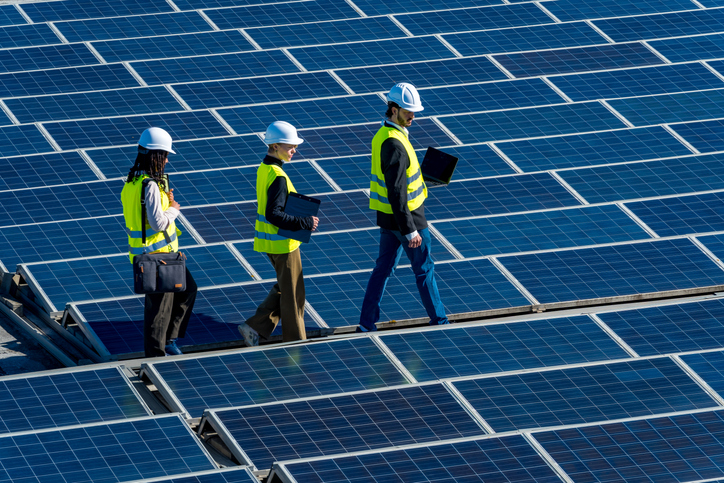
Designing Energy and Industrial Systems for a Better World
Explore energy, industry, and agricultural systems and their interconnections, identifying key leverage points to meaningfully reduce emissions and transform technoeconomic systems.
Course Information
About this Course
Addressing climate change means rethinking the basics of how things are made, used, and disposed of. This course prepares you to find and implement effective, systems-level solutions across a variety of industries - while avoiding false solutions. Learn about electric transmission, electricity generation, industrial energy, and agricultural systems, as well what to do with domains still reliant on fossil fuels and how natural materials can be used to create products that restore the environment rather than extract from it.
What you'll learn
- Explore the challenges, opportunities, and tradeoffs offered by decarbonizing energy systems.
- Discover how to manufacture materials in efficient and regenerative ways.
- Understand coupled energy, industrial, social, and economic systems.
- Apply a systems lens to find climate solutions across industries.
Modules
This course has 6 modules
Electrify everything: Grid-scale needs and how we might achieve them
Clean energy: Electricity for the future
Industrial Energy Demands: Limits and Opportunities in Hard-to-Defossilize Tech
Where are we stuck with fossil fuels, why, and what can we do about it?
Agriculture: Feeding the world without the foodprint
Bioeconomy: Fuels, medicines, and materials for a restorative economy
How you'll learn
 Real-World Learning
Learn from MIT faculty and experts who ground their teaching in real-world cases rather than mathematical models, making the material approachable for all.
 Practical Application
Apply your new knowledge with hands-on, practical exercises drawn from healthcare, sports, finance, sustainability, and more.
 AI-Enabled Support
Deepen your understanding of the course material and get help on assignments from AskTIM, the AI assistant built by MIT researchers.
 Stackable Credentials
Earn an MIT Open Learning certificate at each milestone—module, course, and program—demonstrating your AI expertise. Available in paid courses only.
Prerequisites
The program is designed for non-technical professionals and is grounded in real-world case studies and practical applications. No experience with climate science or engineering is required.
Meet your instructors
Michael Howland
Assistant Professor of Civil and Environmental Engineering
Michael Howland's research group studies environmental fluid mechanics and the modeling, optimization, and control of renewable and efficient energy systems. This work is focused at the intersection of fluid mechanics, weather and climate modeling, uncertainty quantification, and optimization and control with an emphasis on renewable energy systems. They use synergistic approaches including simulations, laboratory and field experiments, and modeling to understand the operation of renewable energy systems, with the goal of improving the efficiency, predictability, and reliability of low-carbon energy generation. Two coupled research themes they are pursuing are: 1) Modeling complex environment-energy system interactions through the use of simulations and experiments; and 2) Leveraging the developed models in full-scale field experiments or case studies to improve the operation and integration of low-carbon generation. (source)